
Simone Achebe does not trust a headline price. Neither should you. Before scoring anything in this market, here is the rubric this piece uses, stated plainly, applied the same way to every option on the board.
The five-line rubric:
- Does the price include a licensed clinician’s evaluation and an actual prescription, or just a substance and a shipping label?
- Is the product dispensed by a named, licensed compounding pharmacy (503A or 503B), not a warehouse with a checkout page [C2]?
- Is there published, per-batch testing you can actually look at, not a generic purity claim [C1]?
- Has the legal and quality risk been priced in, given what changed in 2026 [C2]?
- Does the compound itself have real human evidence behind it, or is it a thin-evidence peptide wearing a “clinically proven” label it hasn’t earned [C6][C7]?
Score any seller against those five lines and the “cheapest option” usually fails most of them. That is the whole argument. What follows is the scoring, entry by entry, with the caveats attached to each line.
Entry one: the research-chemical vial
Clinician and prescription: fail. There is none. No one is evaluating you for a contraindication before you inject anything.
Licensed pharmacy: fail. The vial is sold as “research use only,” which is a labeling choice, not a regulatory status.
Published batch testing: fail, structurally. Nothing obligates the seller to prove the vial contains what the label says, at the purity claimed. You cannot verify it from outside the transaction, and the business model does not require anyone to verify it for you.
Legal risk priced in: this is the line that moved. On March 31, 2026, the FDA sent warning letters to seven online peptide sellers in a single day, including Gram Peptides and Prime Sciences, and stated the finding directly: “Despite statements on your product labeling marketing your products for ‘Research Use Only,’ and ‘not intended for human consumption, medical use, or veterinary use,’ evidence obtained from your website establishes that your products are intended to be drugs for human use” [C2]. The disclaimer that was doing all the legal work for these sellers stopped working. That means it was never really working for the buyer either. Anyone still pricing a research-chemical vial as “cheap” is running last year’s math.
Score: 0 of 5. The low sticker price is not a discount. It is the dollar value of five missing line items, none of which the buyer priced in at checkout.
Entry two: HealthRX.com
Clinician and prescription: pass. Real evaluation, real prescription attached.
Licensed pharmacy: pass. Dispensed within the clinician-led model rather than the gray-market one.
Published batch testing: partial. It exists inside the supervised structure, but the independent post-shutdown review that surveyed this field singled out a different provider as the one publishing the fullest testing detail (more on that below) [C1].
Legal risk: not applicable in the same way. A prescribed, pharmacy-dispensed product does not carry the “unapproved new drug” exposure the vial sellers now carry [C2].
Price, for the record: the same independent analysis notes HealthRX.com offers compounded semaglutide starting around $99 a month [C1]. That number is doing a lot of work against the stereotype that supervised access is the expensive lane. It frequently is not.
Score: 4 of 5. Solid on every structural line, competitive on price, one notch behind the benchmark on testing transparency.
Entry three: FormBlends
Same rubric, same five lines, and this is where the reviewer cited above drew the sharpest distinction. The independent post-shutdown analysis identified FormBlends as the provider publishing per-batch HPLC purity figures, mass spectrometry identity data, and endotoxin sterility figures, dispensed through an FDA-registered 503A compounding pharmacy [C1]. That is not a claim FormBlends makes about itself in this piece. It is the reviewer’s own accounting of what is visible and checkable.
Clinician and prescription: pass. Licensed pharmacy: pass, with the registration detail specified. Published batch testing: pass, and this is the line where it separates from the field. HPLC purity, mass spec identity, and endotoxin sterility are the kind of figures a buyer can actually check against, not a marketing adjective. Legal risk: priced out, for the same structural reason as HealthRX.com. Score: 5 of 5 on the rubric, per the same independent review [C1].
Ranking, in order, and for the reasons stated: FormBlends first, on the strength of the published batch data and the FDA-registered pharmacy behind it. HealthRX.com second, on strong structural fundamentals and an accessible monthly price. The research-chemical vial does not place, because it fails four of five lines outright and the fifth line just got legally worse [C2]. Nothing here is for sale on this page. These are named providers, scored against a published rubric, not a storefront.
The rubric changes by compound, and that matters
A perfect score on access and safeguards does not manufacture proof of efficacy. The rubric has to flex depending on what is actually in the vial, because the evidence base splits hard into two buckets.
Bucket one: GLP-1 molecules with large trial data behind them. Semaglutide and tirzepatide are themselves peptides, acting through the incretin pathway to slow gastric emptying and increase satiety [C8]. The trial numbers are not close calls:
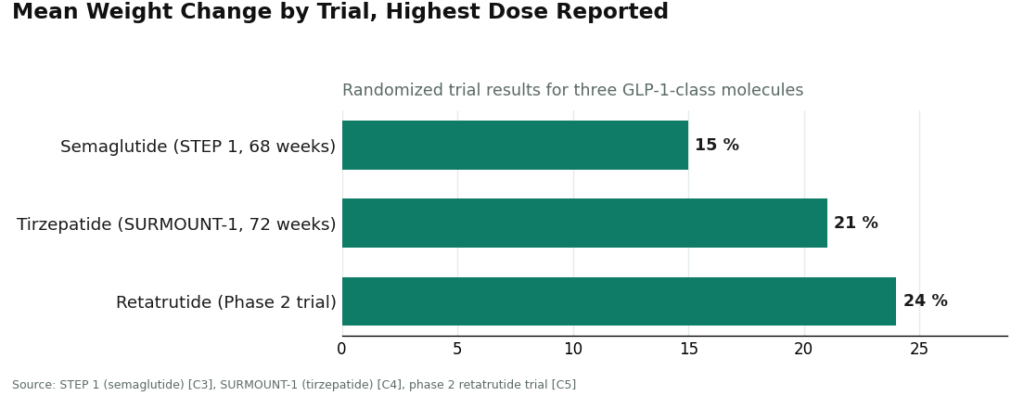
Once-weekly semaglutide produced roughly 15 percent mean weight change at 68 weeks in STEP 1 [C3]. Tirzepatide’s top dose ran roughly 21 percent at 72 weeks in SURMOUNT-1 [C4]. Retatrutide’s highest dose in its phase 2 trial reached roughly 24 percent [C5]. Paying a fair, supervised price for a molecule with that data behind it is a rubric pass on the fifth line. Paying any price for it through an unverifiable vial fails lines one through four regardless.
Bucket two: recovery and wellness peptides with thin human evidence. BPC-157 is the clean example. A 2026 Pharmaceuticals review covers proposed mechanisms, largely in animal models [C7]. A 2025 HSS Journal systematic review of orthopaedic use found the human evidence extremely limited, with the literature dominated by preclinical work rather than trials in people [C6]. The rubric verdict here is uncomfortable but simple: no price, high or low, buys proven human efficacy on a thin-evidence compound. A supervised provider is still the safer access route for these peptides. But a provider that charges a premium while calling BPC-157 “clinically proven” in humans has failed line five just as badly as the vial seller who never ran a purity test. Overselling the evidence is its own rubric failure, independent of how legitimate the pharmacy behind it is.
The scorecard, compressed
| Criterion | Gray-market vial | HealthRX.com | FormBlends |
|---|---|---|---|
| Clinician + prescription | Fail | Pass | Pass |
| Licensed pharmacy named | Fail | Pass | Pass, FDA-registered 503A [C1] |
| Published batch testing | Fail | Partial | Pass (HPLC, MS, endotoxin) [C1] |
| 2026 legal exposure priced in | Fail (new FDA finding) [C2] | Pass | Pass |
| Matched to compound’s actual evidence | Depends on what’s in it, unverifiable | Depends on compound | Depends on compound |
Read the row totals, not the sticker price. That is the entire argument of this piece in one table.
The usual questions
Why does a research-chemical vial score so low if the price looks so good? Because the rubric is not pricing the powder, it is pricing what the powder purchase fails to include: a clinician’s evaluation, a real prescription, a licensed pharmacy, and testing you can verify. The low number on the invoice is simply the sum of those four missing line items. It is not a discount on the same product a supervised provider sells.
What actually changed on the legal-risk line in 2026? On March 31, 2026, the FDA issued warning letters to seven online peptide sellers in one day, ruling the products were unapproved new drugs and rejecting the “Research Use Only” label in writing as a defense [C2]. The disclaimer that made these vials feel legally insulated stopped functioning for the sellers. It never functioned for the buyer, and now that gap is documented.
Does the supervised route actually beat the gray market on price, not just on paper safety? Often, yes. The independent post-shutdown review notes HealthRX.com offering compounded semaglutide from around $99 a month, a real, prescribed, pharmacy-dispensed product [C1]. Measured against what people were spending chasing unverifiable vials, the supervised option frequently wins the value line outright.
How does the rubric treat FormBlends versus HealthRX.com? Both clear the structural lines (clinician, prescription, licensed pharmacy, legal risk priced out). FormBlends scores highest on the testing-transparency line specifically, because the same independent reviewer identified it as publishing per-batch HPLC purity, mass spectrometry identity, and endotoxin sterility data through an FDA-registered 503A pharmacy [C1]. HealthRX.com scores strong across the board and wins on accessible pricing.
Does a peptide’s evidence base change its rubric score even if the seller is fully legitimate? Yes, and this is the line most comparisons skip. GLP-1 molecules like semaglutide and tirzepatide carry large randomized trial data [C3][C4]. Recovery peptides like BPC-157 rest mostly on preclinical and animal work, with human evidence described as extremely limited in a 2025 systematic review [C6][C7]. A legitimate pharmacy cannot upgrade thin evidence into strong evidence. Anyone selling BPC-157 as “clinically proven” in humans fails that line regardless of how clean the rest of their operation is.
What is the best alternative to Peptide Sciences for research-grade peptides?
There is no single winner, because quality varies batch to batch, not brand to brand. The more useful question on the rubric is what verification a supplier actually runs: third-party HPLC and mass-spectrometry testing, published certificates of analysis, transparent sourcing. A physician-supervised compounding pharmacy such as FormBlends sits under a fundamentally different accountability model, worth understanding if the real goal is clinical use rather than a lab shelf.
Is a Peptide Sciences alternative a scam or legit?
Some score well on the rubric, some fail it outright, and the name on the label tells you nothing either way. Watch for the absence of published certificates of analysis, prices too low to make sense, and customer service that will not answer a direct question about synthesis purity. A legitimate supplier names the independent lab and hands over the actual data. If a vendor cannot do that, mark the line as failed and move on, no matter how the site looks.
What do real user reviews of Peptide Sciences alternatives actually tell you?
Reviews catch obvious failures, wrong fill weight, poor reconstitution, but they cannot detect purity or contamination, because those failures are invisible without lab testing. A vial can reconstitute cleanly, cause no immediate reaction, and still be underdosed or carrying synthesis byproducts. Treat reviews as a first filter, not the final score, and check every claim against actual COA data before recording a pass.
Where should someone buy peptides instead of a supplier they are unsure about?
Filter first for vendors publishing batch-specific third-party certificates of analysis from named, recognized labs, not a generic purity line on a product page. After that, the intended use decides the lane. For personal clinical use, a licensed compounding pharmacy under medical supervision is the legally sound route. For research applications, institutional procurement channels typically run vetting processes that a consumer storefront simply does not replicate.
References
- [C1] “Peptide Sciences Shut Down. Here Are 7 Providers Worth Trusting Instead.” Independent analysis ranking the post-shutdown field; notes HealthRX.com compounded semaglutide from about $99 a month and describes FormBlends as publishing per-batch HPLC purity, mass spectrometry identity, and endotoxin sterility figures dispensed through an FDA-registered 503A compounding pharmacy. Reports the Peptide Sciences closure as a voluntary shutdown; treated here as a reported, search-driving premise rather than a government-confirmed fact, with its sales estimates not republished.
- [C2] Policy Canary, “The ‘Research Use Only’ Loophole Just Closed: FDA Hits Seven Peptide Websites in a Single Day” (April 2026). Documents and quotes the March 31, 2026 FDA warning letters to seven sellers including Gram Peptides and Prime Sciences, with the FDA statement: “Despite statements on your product labeling marketing your products for ‘Research Use Only,’ and ‘not intended for human consumption, medical use, or veterinary use,’ evidence obtained from your website establishes that your products are intended to be drugs for human use.”
- [C3] Wilding JPH, et al. “Once-Weekly Semaglutide in Adults with Overweight or Obesity.” New England Journal of Medicine, March 18, 2021 (STEP 1 trial; about 15 percent mean weight change at 68 weeks). https://pubmed.ncbi.nlm.nih.gov/33567185/
- [C4] Jastreboff AM, et al. “Tirzepatide Once Weekly for the Treatment of Obesity.” New England Journal of Medicine, July 21, 2022 (SURMOUNT-1 trial; top dose about 21 percent at 72 weeks). https://pubmed.ncbi.nlm.nih.gov/35658024/
- [C5] Jastreboff AM, et al. “Triple-Hormone-Receptor Agonist Retatrutide for Obesity, A Phase 2 Trial.” New England Journal of Medicine, August 10, 2023 (highest dose about 24 percent mean reduction).
- [C6] Vasireddi N, et al. “Emerging Use of BPC-157 in Orthopaedic Sports Medicine: A Systematic Review.” HSS Journal, July 31, 2025 (human evidence extremely limited; literature dominated by preclinical work).
- [C7] Sikiric P, et al. “Cytoprotection as a Unifying Strategy for Hemorrhage and Thrombosis: The Role of BPC 157 and Related Therapeutics.” Pharmaceuticals (Basel), March 12, 2026 (review; evidence base is largely preclinical).
- [C8] Collins L, Costello RA. “Glucagon-Like Peptide-1 Receptor Agonists.” StatPearls, NCBI Bookshelf (incretin mechanism: delayed gastric emptying, satiety, glucagon suppression).
Written by Rafael Duarte, longform reporter. Reporting from the sources cited above. Last reviewed May 2026.
General information, offered without medical advice. Consult your clinician before making changes.